
Wondering when it’s safe to start exercising after pregnancy? Learn what Dubai-based fitness experts say about postpartum recovery, plus safe timelines and tips for training at home or in your condo gym.
Looking for a safe and guided return to fitness post-pregnancy? Want personalized support rather than general group classes? This blog will look into how it is safe to start running and lifting in the postpartum period.
Rebuilding Strength After Birth
Who said you cannot work out after giving birth? With the right guidance, after a break period, even as a new mum, you can start working out.
As long as you are aware of when we can start exercising after delivery, rebuilding strength after giving birth is not only possible, it is also recommended.
In fact, this is what you need to do as it is beneficial not only for physical but also mental recovery. As you already might know, in the postpartum stage, you must listen to your body and start working out to rebuild your strength.
To start, you need to ask yourself a few questions to find the emphasis for why you need to rebuild your strength. This is the first stage of your motivation. This is why the question is drawn from your intrinsic motivation, and you want to do something enjoyable and interesting to you.
This is critical when you are going for a postpartum workout routine. At this stage, even if you cannot go all out, every bit of effort counts. All you need is to consistently maintain the motivation to rebuild your physical strength as a new mum.
Understanding the Postpartum Body
However, to understand why you would need that motivation and why it should be consistent, you need to develop the necessary knowledge of your postpartum body.
Developing the knowledge of your postpartum body involves recognizing the common physical and emotional changes. The body after childbirth: weakened core, pelvic floor, hormonal shifts, and so on. Many of these changes are temporary. However, to accelerate your recovery, you need to prioritize proper nutrition and a gradual return to physical exercises with accountability.
So, the answer to how to lose weight after pregnancy is exercise, and this exercise would require you to understand your postpartum body. Especially in the case of the rectification of certain issues such as Diastasis recti, joint instability, fatigue, prolapse risk, and so on, where exercise helps these issues from worsening as well as helping in weight loss.
General Guidelines: When Is It Safe to Start Again?
It is safe to start working out with gentle exercises a few days after a normal birth. However, in the case of postpartum exercises after a C-section, it is recommended to wait for at least 6 weeks to get clearance.
Now, here’s a look at the general timeline for when to start depending on your type of delivery:
| Type of Delivery | Recommended Wait Period | Medical Clearance Needed? |
| Vaginal Delivery | 4–6 weeks | Yes |
| C-Section | 8–10 weeks | Yes |
| Complicated Birth | Depends on the physician’s advice | Mandatory |
Table 1: General Timeline for Resuming Workout postpartum
And here, for the earlier stages, you can start with early movement and recovery exercises such as:
- Starting with gentle walks, breathing, and pelvic floor activations.
- Avoid core-intensive and high-impact workouts until a healthcare provider has given you clearance.
P.S., you should not rush returning to working out in the postpartum period. Here’s why you should be careful about returning to your workout routine after childbirth:
- Pelvic organ prolapse is a potential risk
- Your diastasis recti can worsen if return to exercise is not done carefully
- Working out with an unstable core can lead to back or hip pain
- It can also lead to chronic fatigue or burnout
We understand that your body is undergoing certain changes in the postpartum space. Therefore, you feel the need to quickly return to working out to reconnect with your most confident self.
However, this should be done carefully. Or else, you might end up with long-term setbacks in the hope of achieving short-term gains. This is especially pertinent for postpartum C-section exercise, where the complications might be more major compared to a natural birth.
Recommended Postpartum Exercises (Safe, Gentle, and Progressive)
As you might already be aware of, the primary goal during postpartum exercising is to focus on restoration first and then look into intensity. This can deal with certain specific aspects such as posture, mobility, pelvic floor strength, and core control. Start with this first before you move on to more high-impact workouts.
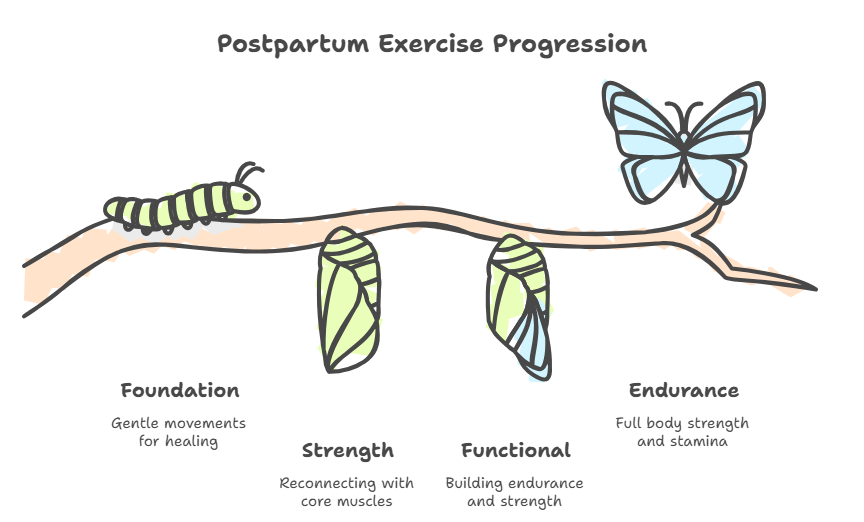
On that basis, here is a stagewise breakdown to postpartum exercises safely and effectively:
Stage 1: Foundation and Healing (The First 1-4 Weeks)
Most experts, especially obstetricians and gynaecologists, would recommend waiting at least 12 weeks postpartum to return to working out. However, before you start, you would need to ensure that you are properly aware of your body’s postpartum conditions.
On that basis, here are some prerequisites before you can start exercising:
- You need to ensure that there are no pelvic floor issues, such as leakage or heaviness.
- Your Diastasis Recti does not exceed 2 cms.
- You have passed low-impact functional tests, such as the ability to walk for 30 minutes without feeling pain.
And then, you can go through the following running readiness checklist:
| Requirement | Safe to Proceed? |
| Cleared by OB-GYN or pelvic PT | Yes/No |
| No pain or heaviness in the pelvic area | Yes/No |
| Able to walk 30 minutes briskly | Yes/No |
| Core activation & balance control | Yes/No |
Table 2: Exercise Readiness Checklist
Before you can start working out, you’ll have to ensure that all of these options are checked as yes. That, along with the prerequisite amount of rest, will be necessary to maintain before you can start your running exercises in the postpartum period.
Based on this, your workout goal in this stage will be to reconnect with your body and activate deep and stabilizing muscles. Here, the recommended exercises include:
- Diaphragmatic (Deep Belly) Breathing: At this stage, focusing on the breathing, circulation, and gentle activation is more worthwhile than on calorie burning.
- Pelvic Floor Contractions (Kegels): Strengthens muscles that are weakened during pregnancy.
- Ankle Circles & Toe Flexes: It promotes blood circulation and reduces swelling.
- Gentle Walking: Gentle walking, even for 5-10 minutes, helps maintain mobility and boosts your mood.
Avoid crunches, sit-ups, or planks as these can worsen abdominal separation or diastasis recti.
Stage 2: Strength Reconnection (Weeks 4-8)
You can start gentle bodyweight exercises as early as 4–8 weeks postpartum, once cleared by a healthcare provider. However, you can only begin heavier lifting after 12 to 16 weeks, depending on your rate of healing.
Here are the aspects of weight training that you should focus on in the postpartum period:
- Core re-engagement
- Pelvic floor strengthening
- Gradual progressive overload
Anything more should be considered very carefully, such as straining or high-impact lifts. These should be avoided initially, along with strength exercises that require holding your breath.
It is important to keep in mind that the path of postpartum fitness is not one-size-fits-all. Everybody is different, and healing takes time. Make sure you have a holistic support system that motivates, guides, and trains you, while at the same time ensuring that the end goal of optimal health is always in sight. You would need to ensure that the appropriate amount of rest is considered, along with a gradual start to the exercise, and slowly picking up the intensity.
Here, the recommended exercises can include:
- Glute Bridges: It can help strengthen hips, glutes, and lower back — crucial for posture and pelvic support.
- Heel Slides: Engages deep core muscles without stressing the abdomen.
- Standing Pelvic Tilts: Improves lower-back mobility and abdominal engagement.
- Wall Sits (Short Duration): Builds leg and core endurance safely.
- Arm Circles or Resistance Band Rows: Strengthens the upper body for carrying and feeding your baby.
And, you should essentially focus on breathing across all the exercises. Breathing is critical when strength training. If your breathing is not accurate, it can affect your core, possibly lead to injuries, and negative impacts on your overall growth.
Stage 3: Functional Strength and Endurance (After 8 Weeks)
In this stage, your goal is to restore overall body strength, stamina, and coordination.
Once you are comfortable performing Stage 2 movements and cleared for moderate exercise, you can then move forward with a more intensive full-body workout session.
Here, the recommended exercises can include:
- Bodyweight Squats: Strengthens legs, glutes, and pelvic stability.
- Modified Push-Ups (on knees or against a wall): Rebuilds chest, arm, and shoulder strength.
- Dead Bugs: Excellent for core control without overstraining the abdomen.
- Stationary Lunges: Engages legs and glutes; improves balance.
- Light Dumbbell Training (2–4 kg): Shoulder presses, bicep curls, and lateral raises for upper-body tone.
- Walking Intervals: Combine brisk walking with slower recovery intervals to boost cardiovascular fitness.
You should avoid high-impact exercises, such as running, jumping, heavy weights, and so on, until your pelvic floor and abdominal strength are fully restored.
Everyday Functional Movements
Other than specific exercises, you will also have to remember that even daily activities can count towards your postpartum recovery. These can include:
- When you are carrying your baby, you need to ensure the correct posture. The correct posture is- shoulders back and knees slightly bent.
- Try to squat to pick up objects more often than bending. This is more so important when carrying a baby in your arms.
- Your core needs to be engaged when you are performing daily tasks, such as lifting a diaper bag or a stroller.
These small adjustments can help protect your back, support muscle tone, and prevent injury — it can be essential for new mothers juggling daily tasks.
Nutrition and Recovery Support
Other than working out, another very important aspect to consider will be the importance of balanced postpartum nutrition. The primary nutritional needs for new mothers should generally involve proteins, irons, and hydration.
However, for breastfeeding mothers, you should always keep in mind that managing calorie intakes is critical, as your diet is now also linked with your newborn’s health.
With our multipronged approach to postnatal fitness, we offer dedicated nutritionists who specialize in postnatal supplements and diets.
Mental Health and Community Support
The ability to move better makes you feel like you are getting closer to feeling yourself again. And that can be a massive support to your well-being as a new mum, by reducing postpartum blues.
In Dubai, you can find different supportive mom communities who meet up often to discuss mental and physical wellness, and are known to support each other. So, with them, you can even find a group to participate in exercise sessions with.
Final Tips for a Safe and Sustainable Routine
To undertake a safe and sustainable exercise regimen, you need to first listen to your body. This means that you should progress at a pace that is most convenient to you. If anything goes wrong, it can lead to injuries.
The best way to progress here will be to combine rest, hydration, and a gradual increase in load. And always go for a consultation session before starting a new workout. This session can be either with your OB-GYN or a women’s health physiotherapist.
The Dubai Advantage: Training from Home or Condo Gym
As a new mum, you might find it difficult to find time out of your extremely busy schedule to go to the gym to work out. That is why there’s an option available for you in Dubai to train at your home or your condo gym at the same level of efficiency as your home.
This can be possible with a team of personal trainers, nutritionists, and accountability coaches, ready to show up with the appropriate equipment and routine at your doorstep. All you need to do is show up with the right motivation.
These teams will help you reach your postpartum workout goals as long as you are consistent with your efforts and you maintain the urge to achieve the goals you have set. Therefore, be it postpartum belly fat exercises or any other form of workout, as long as your goals are maintained, the team can offer you the right solutions.
However, if you still want to know whether a Condo Gym and At-Home, here’s a list:
| Feature | Condo Gym | At-Home Training |
| Equipment access | Moderate | The trainer brings the necessary gear |
| Privacy | Medium | High |
| Baby nearby | Yes | Yes |
| Trainer convenience | Yes | Yes |
| Space needed | Small area (2m x 2m is enough) | Living room or bedroom corner |
Table 3: Condo Gym vs At-Home Postpartum Training Comparison
Key Takeaways: Fitness After Birth Is a Process
Wait for clearance, listen to your body, and work with a professional. Avoid comparing yourself to social media or other mums. Start small—even 20 minutes twice a week can make a difference. Whether in your living room or building gym, consistency is what counts.
Ready to Start Your Postpartum Workout?
Ready to move again, safely? Book a FREE consultation with a certified postnatal trainer in Dubai. Work with a trainer, an accountability coach, and a nutritionist to create the perfect workout plan!
Frequently Asked Questions (FAQs)
Yes. If you have undergone a normal childbirth, you can start working out at 6 weeks postpartum, as long as you have run the readiness check.
If you are working out at your home or from your condo gym, yes, you can have your infant present with you. We understand that the mother’s duty comes first.
You would need to wait for at least 12 or 16 weeks at least if you want to work out your strength after a C-section. But it is still a valid option.
No. The accountability and nutrition coaches will not visit you at your home. They will keep in touch with you through virtual meetings, while occasionally they will also visit you at your home.