
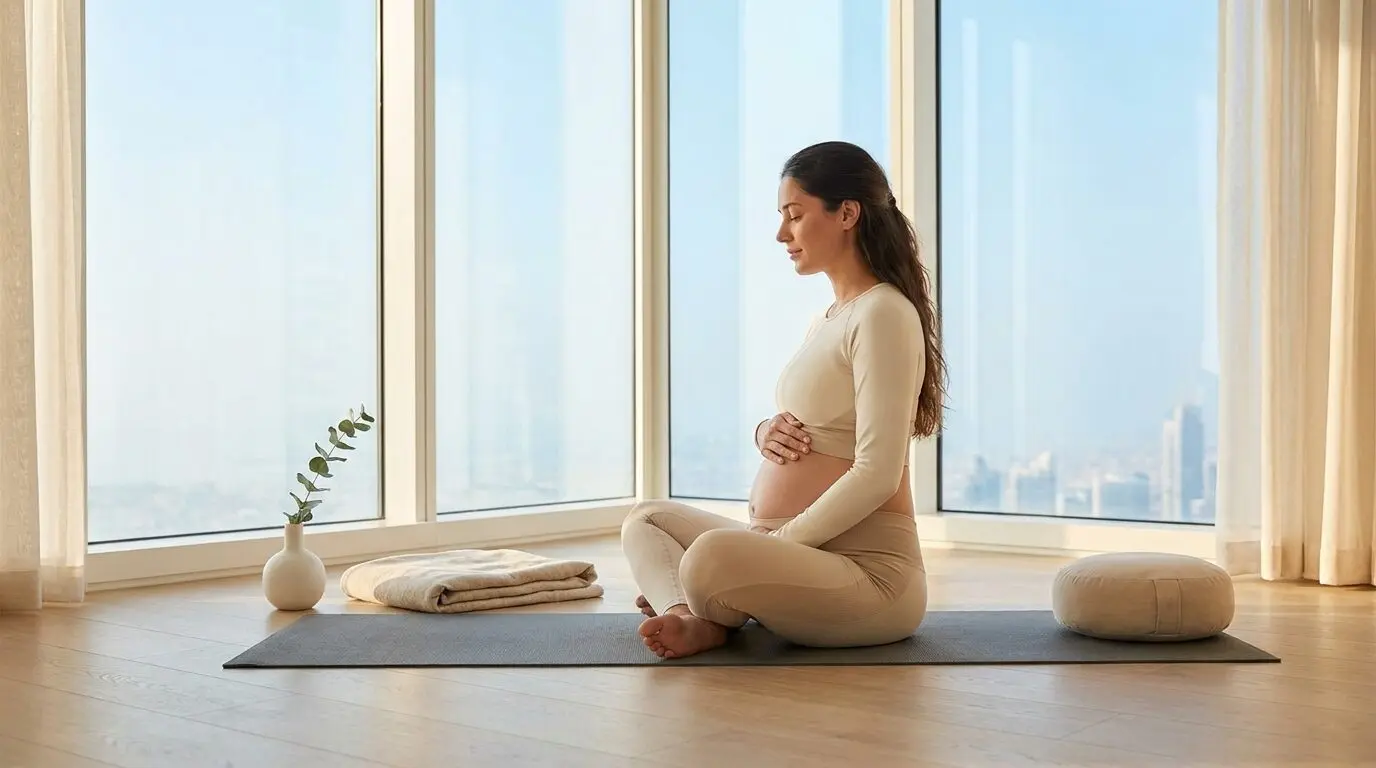
Pregnancy in Dubai comes with its own logistics. Long summers indoors. A medical system that ranges from world-class to overcautious. Family back home asking what you are doing for "the baby". And in the middle of all that, a body changing faster than you can read about it.
Prenatal yoga is one of the most studied, safest, and most genuinely useful things you can do during pregnancy. This guide is built specifically for expecting mums in Dubai. What to do, what to skip, where to find qualified teachers, and how to set up a practice at home if a studio does not fit your schedule.
Why Prenatal Yoga Matters During Pregnancy
The benefits are not "wellness" claims. They are documented in multiple studies published in journals like the BMJ, the Journal of Alternative and Complementary Medicine, and Obstetrics & Gynecology.
- Shorter labour. Studies of women who practised prenatal yoga in the third trimester showed first-stage labour reductions averaging 90 minutes.
- Lower pain perception. Regular practice is associated with reduced pain ratings during contractions.
- Better sleep. Particularly in the third trimester, when sleep becomes scarce.
- Reduced lower back and pelvic pain. The most common pregnancy complaint, addressed directly by gentle hip openers and pelvic tilts.
- Lower anxiety and depression scores. Both during pregnancy and postpartum.
- Improved blood pressure. Especially helpful in pregnancies with mild hypertension.
- Stronger pelvic floor. Which translates to easier delivery and faster postpartum recovery.
Three benefits stand out for women in Dubai specifically: heat tolerance through breathing work, a structured indoor activity for the long summer months, and a community for what can be an isolating experience for expat mums.
When to Start Prenatal Yoga
Most teachers and obstetricians recommend starting between weeks 12 and 14 of pregnancy, once the first scan has confirmed a healthy pregnancy and the highest miscarriage risk window has passed.
If you were already practising yoga before pregnancy, you can continue with modifications from very early on. If you are completely new to yoga, the second trimester (weeks 14 to 27) is the ideal starting point. Energy is at its highest, morning sickness has typically resolved, and the body has adapted to early pregnancy changes.
Always confirm with your OB-GYN before starting, especially if you have a history of miscarriage, are carrying multiples, have placenta previa, gestational diabetes, or pregnancy-induced hypertension.
Prenatal Yoga by Trimester
Pregnancy is not one continuous experience. Each trimester has different needs. Generic yoga classes do not adjust for this. Properly trained prenatal teachers do.
Trimester 01
Weeks 1 to 13: Foundation
Most women have not started a formal prenatal practice in the first trimester. Energy is often low, morning sickness is common, and miscarriage risk is highest. If you do practise, focus on gentle breathing, restorative poses, and mental preparation.
Recommended poses
- Cat-Cow (Marjaryasana-Bitilasana). Gentle spine mobility.
- Child's Pose (Balasana) with knees wide. Restorative.
- Seated forward fold with a pillow between belly and thighs. Gentle.
- Side-lying Savasana on the left side with a pillow between knees.
- Diaphragmatic breathing for 5 to 10 minutes daily.
Trimester 02
Weeks 14 to 27: The Sweet Spot
Energy is back. Nausea has usually settled. The bump is visible but not yet uncomfortable. This is when most women begin a structured prenatal yoga practice. You can move more freely, hold poses longer, and build genuine strength for labour.
Recommended poses
- Wide-legged squats (Malasana, supported with blocks). Opens hips and pelvic floor.
- Modified warrior poses (Warrior I and II). Builds leg strength.
- Triangle pose (Trikonasana, modified with hand on a block).
- Tree pose (Vrksasana) with hand on a wall for balance.
- Seated cobbler's pose (Baddha Konasana). Hip opener.
- Cat-cow flows linked with breath.
- Side-lying Savasana for relaxation.
Trimester 03
Weeks 28 to 40: Preparation
The bump is now significant. Sleep is shorter, swelling is common, and the focus shifts entirely to preparing the body and mind for labour. Practice becomes shorter, more restorative, and more focused on breathing techniques you will use during contractions.
Recommended poses
- Supported squats with the back against a wall.
- Cat-cow for back relief.
- Modified pigeon pose with knees wide.
- Hands-and-knees position with hip circles.
- Restorative side-lying poses with multiple pillows for support.
- Seated meditation with focus on breath.
- Birthing breath practice (4 in, 8 out through pursed lips).
Three Breathing Techniques That Help in Labour
If you only do three things from this guide, do these. The breath is the single most useful tool you carry into labour, and the only one that works whether you have an unmedicated birth, an epidural, or a caesarean.
1. Diaphragmatic Breathing
The foundation. Sit comfortably or lie on your left side. Place one hand on your chest, one on your belly. Inhale through the nose for 4 counts, feeling the belly expand under your hand. Exhale through the mouth for 6 counts. Practise 5 minutes daily from week 14 onwards.
2. Alternate Nostril Breathing (Nadi Shodhana)
Calms the nervous system. Sit comfortably with spine tall. Use your right thumb to close the right nostril, inhale through the left for 4 counts. Close left with your ring finger, release thumb, exhale right for 4. Inhale right, close right, exhale left. Repeat 5 rounds. Excellent for anxiety spikes in late pregnancy.
3. Birthing Breath
The breath you will actually use during contractions. Inhale slowly through the nose for 4 counts. Exhale slowly through pursed lips for 8 counts, as if cooling soup. Practise this from week 28 onwards, several times a day. Your goal is for it to feel completely automatic by labour.
The breath is the only labour tool that works whether you have an unmedicated birth, an epidural, or a caesarean.
What to Avoid in Prenatal Yoga
This list applies to all three trimesters:
- Hot yoga. Bikram or any heated practice. The elevated body temperature is genuinely risky.
- Lying flat on the back after week 16. Compresses the vena cava and can reduce blood flow.
- Deep twists. Compresses the abdomen.
- Deep backbends. Strain on the abdominal wall and lower back.
- Strong core work. Planks held longer than 30 seconds, sit-ups, ab crunches, hollow body holds.
- Jumping movements. Including jump-throughs and jump-backs in vinyasa flows.
- Inversions you were not already doing. Pregnancy is not the time to learn headstands.
- Holding your breath. Free flow of oxygen to the baby is essential.
- Anything that hurts. Pregnancy is not the time to push through.
Where to Practise Prenatal Yoga in Dubai
Group Studio Classes
Several Dubai studios offer dedicated prenatal classes, including options in Marina, Jumeirah, Business Bay, and Al Quoz. Group classes are great for community and meeting other expecting mums. Look for teachers with RPYT certification (Registered Prenatal Yoga Teacher, 85 hours of specialised training) or equivalent.
One-to-One Prenatal Yoga at Home
For many of our clients in Dubai, at-home prenatal yoga is the most practical option, especially in summer. A qualified teacher comes to your home with the props you need (yoga pillows, blocks, blankets) and tailors each session to your trimester, energy level, and any pregnancy considerations.
This is what we offer through our prenatal personal training service. Sessions can be pure prenatal yoga, prenatal strength, or a combination depending on what you need that week. Trainers are REPs certified with prenatal qualifications and work alongside your obstetrician.
Considerations for Dubai Mums
- Summer (May to September). Studio commutes in 45 degree heat are exhausting in late pregnancy. At-home sessions become significantly more practical.
- Modesty preferences. One-to-one sessions allow for privacy that some clients prefer.
- Bed rest scenarios. Some pregnancies require limited movement. Modified at-home prenatal yoga can still happen safely with proper guidance.
- Travel between emirates. If you live in Abu Dhabi or Sharjah and work in Dubai, an at-home option avoids the commute.
Want a private prenatal session at home?
Book a free 20-minute consultation with a REPs certified prenatal trainer
Personalised prenatal yoga and strength sessions delivered in your home across Dubai. Sessions tailored to your trimester, energy, and any pregnancy considerations.
Book Free Consultation Or contact us on WhatsAppHow Prenatal Yoga Compares to Prenatal Strength Training
Yoga and strength training are not competitors. They complement each other, and the strongest prenatal programmes combine both.
Prenatal yoga develops mobility, breathing, body awareness, mental calm, and labour preparation. Lower physical intensity. Strong on the mind-body link.
Prenatal strength training builds the muscle and bone density that pregnancy and postpartum demand. Targets the glutes, back, and pelvic floor specifically. Higher physical intensity (still scaled appropriately).
For most expecting mums, two sessions of prenatal yoga and two sessions of prenatal strength training per week is an excellent balance. We programme this combination for many of our female personal training clients in Dubai.
Common Prenatal Yoga Mistakes
- Continuing your pre-pregnancy yoga class. Generic vinyasa classes are not designed for pregnancy. The teacher cannot give you the attention you need.
- Following YouTube videos for the entire pregnancy. Useful as a supplement, risky as your only source. No video can see your alignment or adapt to your specific pregnancy.
- Pushing through discomfort. Pregnancy is the one time "no pain, no gain" should be ignored completely.
- Skipping the first trimester completely. Even gentle breathing work in the first trimester sets up better outcomes later. Consult your doctor first.
- Stopping in the third trimester. The third trimester is when prenatal yoga becomes most valuable for labour preparation. Do not stop.
Postpartum Yoga: Looking Ahead
The pregnancy ends. The body's work does not. Postpartum yoga (different from prenatal) is what helps the abdominal wall, pelvic floor, and overall body recover.
The general guidance is to wait until your 6-week postpartum check before resuming yoga (8 to 12 weeks for caesarean recovery). Even then, start gently. The same teacher who knows your prenatal practice will programme your postpartum return effectively.
This is a gap most studios do not bridge. Continuity from prenatal to postpartum, with the same coach who worked with you through pregnancy, is one reason our clients stay with us through the first year of motherhood and beyond.
This article is for general information and is not medical advice. Always consult your obstetrician before starting or modifying any exercise programme during pregnancy. Stop immediately and contact your doctor if you experience bleeding, severe pain, dizziness, contractions, or reduced fetal movement during or after practice.