
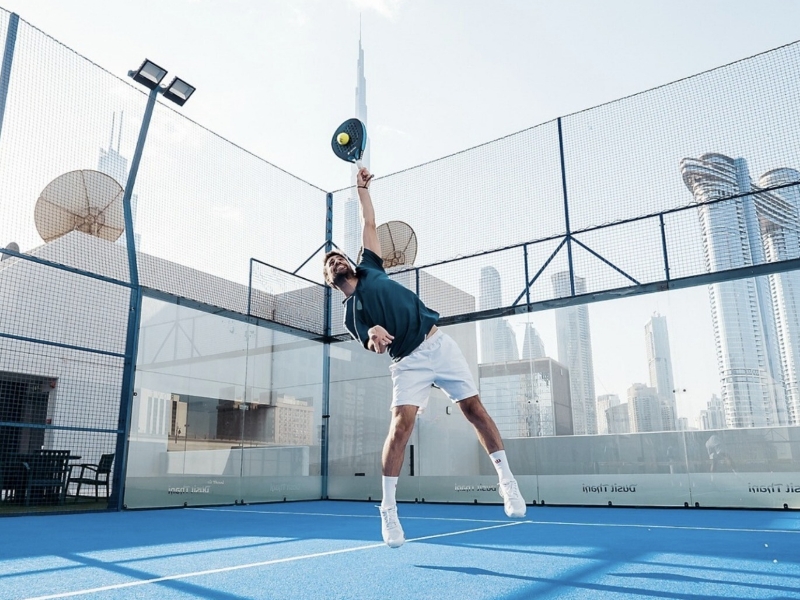
Padel has gone from a niche import to one of Dubai's most popular sports in under five years. Courts at Real Padel Club, ISD Dubai, The Smash Room, Padel Pro, and dozens of newer venues are booked solid from 6 AM to past midnight. The flip side: Dubai sports clinics are seeing a sharp rise in racket sport injuries, most of them preventable with the right preparation.
This guide covers the five injuries we see most often among padel players in Dubai, why they happen, and the structured strength training approach that protects against them. It is written by the team at Athleaders, where many of our clients across Dubai Marina, Business Bay, JBR, JLT, Palm Jumeirah, and Arabian Ranches play padel two to four times a week.
The Padel Boom and Its Hidden Cost
Dubai now has well over 250 padel courts and the number keeps climbing. The sport is appealing because it has a low entry barrier, social format, and is genuinely fun within minutes of picking up a racket. That same low entry barrier is the problem. Most recreational players started padel without prior racket sport training, do not warm up, and play multiple intense matches each week with no off-court conditioning to support their bodies.
The injuries that follow are not random. They cluster around five specific patterns that anyone who has spent time around Dubai's padel scene will recognise.
The 5 Most Common Padel Injuries in Dubai
Injury 01
Tennis Elbow (Lateral Epicondylitis)
The most common padel injury we see, and the one that ends most amateur seasons in Dubai. Tennis elbow is inflammation of the tendons that attach forearm muscles to the outside of the elbow. It builds gradually, then becomes impossible to ignore.
Why it happens in padel: The repetitive forehand and backhand motion, gripping the racket too tight (a near universal beginner mistake), and off-centre contact with the ball all load the same tendon thousands of times per match. Add three matches a week with no recovery and the tendon never gets a chance to heal.
Injury 02
Rotator Cuff Strain
The rotator cuff is a group of four small muscles that stabilise the shoulder joint. Padel demands explosive overhead smashes, fast eccentric loading on off-the-back-wall returns, and repeated overhead serves. That combination is hard on cuff tendons that were already neglected by years of desk work.
Why it happens in padel: Most adults in Dubai have weak external rotators and underdeveloped upper back muscles from sitting at a desk. The shoulder relies on these muscles to stay stable during overhead movements. Without them, the cuff tendons take the load and eventually fail.
Injury 03
Lower Back Pain
Padel requires constant rotation, lunges for low balls, and explosive starts and stops. For anyone with tight hips and a weak core (which describes most desk-bound Dubai professionals), the lower back ends up doing work it was not designed to do.
Why it happens in padel: Tight hip flexors restrict rotation, so the lumbar spine compensates. Weak glutes mean the back extensors fire instead. Over a season, this creates muscular strain or facet joint irritation. In some players it progresses to disc problems.
Injury 04
Knee Injuries (ACL, Meniscus, Patellar Tendinopathy)
The smallest court in racket sports forces the most direction changes per minute. Sudden lateral lunges, decelerations, and pivots stress the knee in ways recreational players are rarely prepared for. Outcomes range from chronic patellar tendinopathy ("jumper's knee") to acute meniscus tears and ACL injuries.
Why it happens in padel: Weak glutes allow the knee to collapse inward during cuts. Underdeveloped single leg strength means the knee absorbs forces it cannot handle. Tight calves and stiff ankles transfer load up the chain. Court surface variations between venues add another variable.
Injury 05
Achilles Tendinitis and Ankle Sprains
Padel rewards explosive sprints to the net and aggressive landings after overhead shots. That puts the achilles tendon and the lateral ankle ligaments under repeated stress. Over time, the achilles thickens and gets painful. In acute cases, players roll their ankle on a sudden direction change.
Why it happens in padel: Tight, weak calves cannot absorb landing forces. Poor balance and proprioception mean the ankle does not stabilise quickly enough. Old, untreated ankle sprains leave the joint chronically unstable.
You do not get hurt because padel is dangerous. You get hurt because you play padel without training for padel.
Why Are Padel Players in Dubai Getting Hurt So Often?
Three patterns explain almost every injury we see in our Athleaders client base:
1. The Weekend Warrior Pattern
Two or three matches over a Friday and Saturday, then nothing structured during the week. The body is asked to perform like an athlete on the court but never trained like one off it.
2. The Skipped Warm-Up
Most players arrive five minutes before the booking, walk on court, and start playing. Air conditioned courts make the problem worse because cold muscles do not absorb impact well. The first ten minutes of play become the warm up, which is when most acute injuries happen.
3. Underdeveloped Supporting Muscles
People play padel. They rarely train for padel. The rotational core, posterior chain, single leg strength, and shoulder stability that the sport demands are not built by playing alone. They are built in a structured strength programme away from the court.
Already feeling something?
Get a free 20-minute consultation with a REPs certified trainer
If you have a niggle that has not gone away in two weeks, or you simply want a structured plan that fits around your court schedule, we will design one. No obligation, no sales pitch.
Book Free Consultation Or contact us on WhatsAppThe 3 Phase Padel Injury Prevention Plan
This is the framework we use with our padel-playing clients. It is not a prescription, and individual programmes always vary based on the player's history, schedule, and current fitness. Use it as a structural guide.
Phase 1: 10 Minute Pre-Match Dynamic Warm-Up
The single most controllable injury reduction tool. Done before every match without exception:
- 2 minutes of light cardio (jogging in place, jumping jacks)
- World's greatest stretch, 5 reps each side
- Arm circles forward and backward, 10 reps each direction
- Lateral lunges, 8 reps per side
- Mini-band lateral walks, 10 steps each direction
- 10 jump squats
- 10 controlled shadow padel swings on each side
Phase 2: Off-Court Strength Work, 2 to 3 Times Per Week
Five training pillars cover everything padel demands:
- Posterior chain: Romanian deadlifts, hip thrusts, single-leg RDLs
- Rotational core: Pallof press, cable woodchops, dead bugs
- Shoulder stability: Face pulls, external rotations, Y-T-W raises
- Single-leg power: Bulgarian split squats, lateral lunges, step-ups
- Forearm and grip: Farmer carries, wrist curls, dead hangs
Two structured sessions per week is the sweet spot for most recreational players. Three sessions if you compete or play four-plus times per week.
Phase 3: Structured Recovery
Recovery is where adaptation happens. Without it, training and matches just stack fatigue:
- 24 to 48 hours between high-intensity matches
- 7 to 9 hours of sleep
- Hydration, especially in Dubai's heat
- Mobility work (foam rolling, hip openers, thoracic extensions)
- Soft tissue work or sports massage every 2 to 3 weeks
Red Flags: When to See a Professional
Some symptoms mean stop playing and book a session with a qualified physiotherapist or sports doctor immediately. Do not push through:
- Pain that wakes you at night
- Swelling that does not reduce in 48 hours
- Joint locking or giving way
- Numbness or tingling down the arm or leg
- Pain on simple daily tasks like climbing stairs or reaching overhead
Once the acute phase is over, a qualified personal trainer is the right partner to rebuild the strength, mobility, and movement quality you need to return to padel without re-injury.
How a Personal Trainer in Dubai Helps
The most efficient injury prevention investment a recreational padel player can make is two structured strength sessions per week with a coach who understands the sport. At Athleaders, that looks like:
- Sport-specific assessment covering rotation, single-leg control, shoulder mobility, and movement quality
- A programme built around your court schedule so strength work supports your matches instead of competing with them
- Trainers who come to you at home, in your building gym, or at a venue you choose, with a full kit (TRX, resistance bands, glute bands, agility ladder, yoga mat). Dumbbells and kettlebells available on request
- A nutrition coach in your team to handle hydration, protein intake, and recovery basics
- An accountability coach who keeps you on track between sessions
Our REPs certified trainers work with padel players across more than 40 Dubai communities. Pricing starts from AED 305/hr for individual training, AED 165/hr per person for buddy training with a partner who also plays.